
Conversation examples
Two conversations before an oncology consultation — same diagnosis, same twenty minutes. The difference is not in the diagnosis or the time available, but in what the patient brought and how the conversation started.
The doctor’s replies in these examples deliberately carry no medical content: the page shows the shape of the conversation and what changes in the answer. The content of that answer is different in every case, and substituting an invented clinical example would misrepresent the point.
A conversation that commits no one
— Doctor, something is wrong with me, please take a look.
— Tell me what bothers you.
— Weakness, it pulls here, sometimes my head.
— Understood. Let us run tests, then we will see.
No diagnosis is named, no basis is named, no options are on the table. The answer could have been anything — and in the next visit the conversation starts from the same place.
The same visit, with preparation
— Since March it pulls on the right, by June it became more frequent. Here is the ultrasound report from April and the labs from May. On what basis was the diagnosis made?
— …
— What treatment methods exist for this diagnosis?
— …
— Which of them are available at this clinic?
— …
— Why is this one proposed — in my case?
— …
— When and how will we check that the chosen approach works?
— …
The doctor names the diagnosis and its basis, not only the conclusion. The patient learns that options exist and which of them are available at this clinic. They hear why the choice is explained in their own case, and they leave with a plan rather than an opinion.
Five questions for the visit
Without them no decision is made — even when the visit is short. The same wording is on the printable form and in the diagram below.
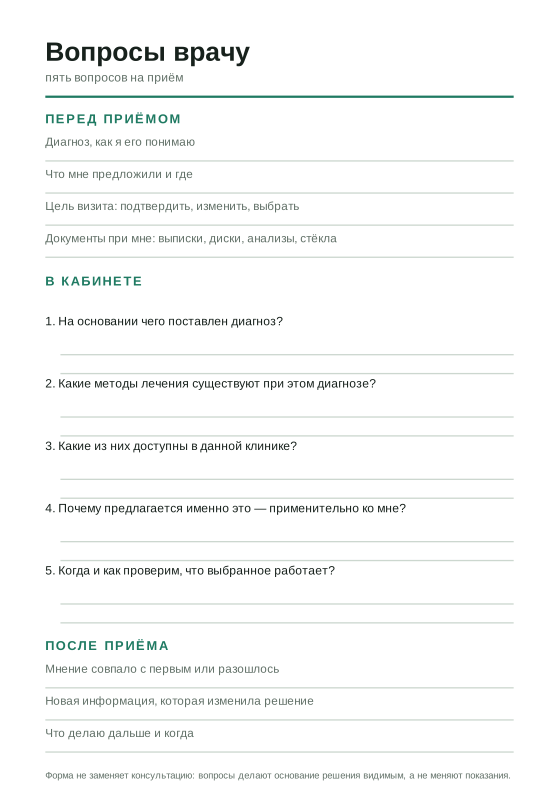
- On what basis was the diagnosis made?
- What treatment methods exist for this diagnosis?
- Which of them are available at this clinic?
- Why is this one proposed — in my case?
- When and how will we check that the chosen approach works?
Everything else is a follow-up: who performs the procedure, what has to be bought separately, what to do if things get worse. If there is no time left for them, they can be asked in writing.
If there is no answer
|
Five steps — in the same order as the questions above. On the left, what should be said; on the right, what to ask if the answer is missing. The diagram does not replace a consultation: it shows what to ask. Refused care or a demand for payment are not part of this list: they are handled with a written request (see below), not by continuing the medical questionnaire. |
|
What it looks like on paper
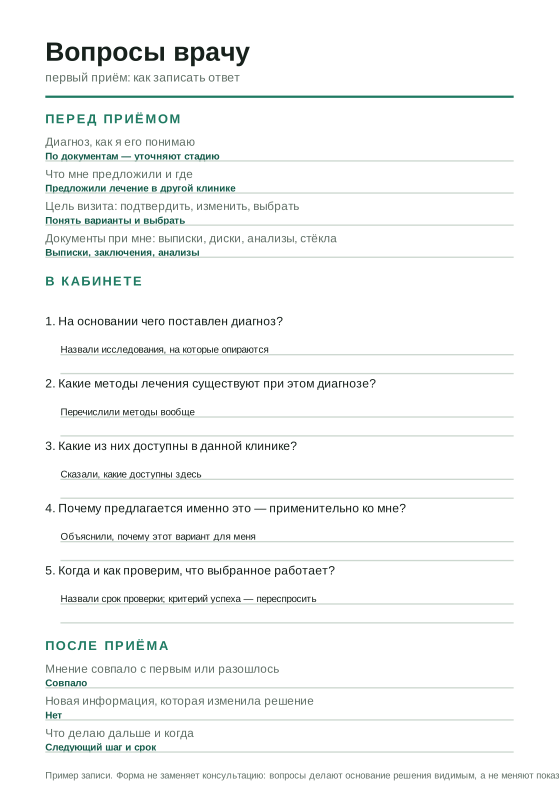
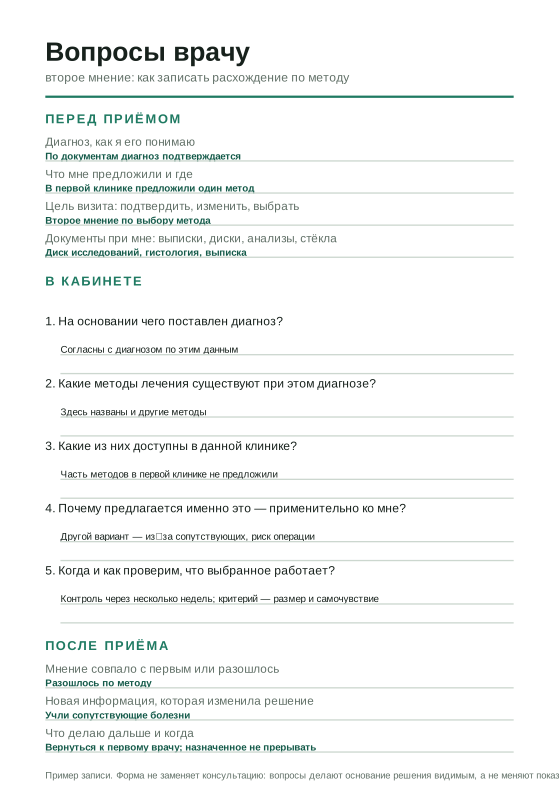
The printable forms are in Russian.
- Blank A5 form — five questions and space for answers
- First visit: how to write down the answers — the shape of a record, not a clinical case
- Second opinion: how to record disagreement on the method — same form, opinions differ; prescribed treatment is not stopped on your own
Refused care or a payment demand
If care was refused, you were queued without a date, or you were asked to pay for something that should be covered by the public programme, the five-question conversation does not replace a written request. At the visit you can state the point and ask for a written reply:
— On what grounds? Please name them.
— What is covered by the programme for my diagnosis, and what is not?
— If this is offered for payment — why, and where can I get it free of charge?
— Can I have this in writing?
Ask for a written answer to a written request, with a copy and a receipt stamp — not for a “refusal form”. Do not stop prescribed treatment on your own while there is no alternative agreed with a doctor.
What this conversation does not promise
A prepared conversation makes the basis of a decision visible — and nothing more. It does not change the indications and does not override what has been prescribed: treatment is changed by the doctor, and a second opinion is sought alongside the plan, not instead of it. If a question stays open, that is a result too — it is worth writing down.
This page is not a consultation. What the service includes and how preparation works are described separately: services and concept.